Splicing Vision Into a Frozen GPT: Building a Minimal VLM From Scratch
Part of embodied-gpt — Phase 2.
By the end of the last post, CLIP could do something genuinely satisfying: hand it 8 real test images and 8 real captions, and it matches all 8 correctly. Two independent towers, aligned into one shared space, no cheating. But retrieval isn’t generation. CLIP can tell you which caption fits an image out of a fixed pool — it can’t write you a new one. My GPT, meanwhile, writes fluent sentences all day, but has never seen a pixel in its life. The obvious next question: can I get the GPT to actually describe an image, using CLIP as the eyes?
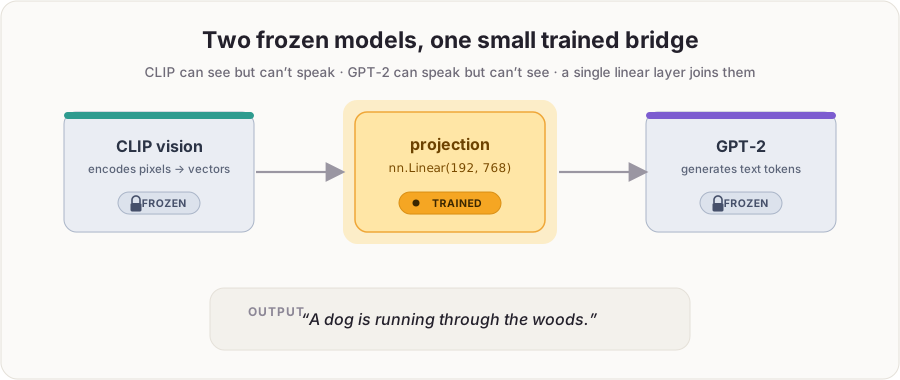
The problem
The last post spent a whole section on why you can’t just wire two independently-trained models together — a vector only means something relative to the space it was shaped in, and CLIP’s image space and GPT’s token-embedding space were shaped by two completely different objectives. CLIP fixed exactly one version of that problem: it aligned an image tower and a text tower into a shared space, purpose-built for cosine similarity comparisons between the two.
Here’s the part I didn’t expect going in: aligning two spaces for comparison doesn’t make either one usable as input to some third, unrelated model. My GPT was trained entirely on its own vocabulary’s token embeddings — it has never seen a CLIP vector, aligned or not, and there’s no reason its attention layers would know what to do with one dropped in raw. CLIP solved “do these two things mean the same thing,” not “can a frozen pretrained model read this.” That’s a second, separate translation problem, and it’s the actual subject of this post: how do you get a vector from any space to be legible to a specific, already-trained, otherwise-untouched model?
Historical context
The state of the field before this, once again a bespoke-architecture-per-task story: image captioning meant a CNN encoder feeding an RNN or transformer decoder, trained end-to-end from scratch on paired (image, caption) data. Every new captioning system was its own model, no reuse. Meanwhile GPT-2/3 had already shown, in text, that one frozen pretrained model could be repurposed across many tasks just by changing what you feed it.
Frozen (Tsimpoukelli et al., DeepMind, 2021 — “Multimodal Few-Shot Learning with Frozen Language Models”) asked whether that idea could extend to vision: keep a pretrained LLM’s weights completely untouched, and train only a vision encoder whose job is to map an image into a handful of vectors that live in the LLM’s existing embedding space — prepended in front of the text prompt as if they were extra tokens. Nothing about the LLM changes. The vision encoder is trained using the frozen LLM’s own next-token loss as the only signal, and the LLM’s language ability transfers to images it was never trained on — because as far as its attention layers can tell, those vectors are just more tokens.
LLaVA (Liu et al., 2023 — “Visual Instruction Tuning”) is the version of this idea that actually matches what I built: instead of training a vision encoder from scratch against that weak, indirect signal, start from CLIP’s already-pretrained encoder (frozen), and train only a lightweight projection layer to translate its output into the LLM’s space. I asked, at the time, why you couldn’t just skip CLIP and train the vision encoder from scratch the way Frozen did — worth stating the actual answer here, because it’s the reason this post starts from last post’s CLIP checkpoint instead of a blank vision encoder:
- Signal density. CLIP’s contrastive loss gives every image a batch’s worth of hard negatives to be discriminated against — a dense, forceful “what specifically makes this different from everything else here” pressure. Caption-prediction loss gives a much weaker, indirect signal: the gradient has to travel through “did the right word get predicted” to say anything about what’s actually in the image.
- Data scale. CLIP: 400 million pairs (or, in my case, whatever signal 6,000 Flickr8k images can give a contrastive objective — still denser than the alternative). LLaVA’s own alignment stage: ~558K captions. Not remotely enough to discover “vision” from a random initialization using only the weak signal above.
- Bootstrapping. A random-init vision encoder outputs meaningless vectors. The projection layer has nothing coherent to map, the LLM has no reason to attend to any of it, and no useful gradient reaches either one. Starting from CLIP means the projection layer’s job is well-posed from step one: translate between two spaces that already mean something, instead of discovering meaning and translating it at the same time.
Intuition: it’s the same trick, one level up
patch_embedding.py, all the way back in Phase 1, was a linear projection of raw pixels into a
space the ViT’s attention blocks already knew how to operate over. This is that exact move, run
twice: pixels → (frozen CLIP ViT) → CLIP’s space → (trained projection layer) → GPT’s space →
(frozen GPT) attends over it like any other token.
A doubt worth naming: pooled vector, or the whole grid?
My first guess at the projection layer’s shape was nn.Linear(d_clip, d_gpt) applied to something
shaped (B, N, d_clip) — right on the mechanism, but I hadn’t checked it against my own code yet.
ImageEncoder.forward() (the one CLIP training actually uses) returns a single pooled vector per
image, (B, proj_dim) — exactly right for a contrastive loss that needs one embedding per image to
compare against one embedding per caption. But that pooled [CLS] vector is a summary,
compressed specifically for whole-image-vs-whole-caption matching. Feeding the GPT one blurry
gestalt vector throws away everything spatial. What the GPT actually needs is the full grid of
patch tokens — x[:, 1:], shape (B, 64, 192) for a 128px image cut into 16px patches — so it gets
64 individually-attendable image tokens, the same way it gets one embedding per word instead of one
embedding for the whole sentence. I added forward_patch_tokens() alongside the existing method
rather than changing it, specifically so the already-trained CLIP checkpoint didn’t need
retraining just to expose a different slice of the same computation.
Same loss as always — just a new question about where it applies
The training objective here isn’t new machinery: it’s the exact next-token cross-entropy loss GPT
was always trained with. What’s new is which tokens count. The combined input sequence is
[image tokens] + [caption tokens], and every position’s logits try to predict the next position’s
token — but image tokens aren’t drawn from a vocabulary, so most of them have no discrete target to
be scored against at all. Only one image position matters for the loss: the very last one, whose
“next token” is the caption’s real first word — the actual image → text handoff. From there it’s
ordinary shifted-label language modeling through the end of the caption. (Full LLaVA has a second
stage — unfreeze the LLM too, train on instruction-style data with the question also masked out
of the loss, not just the image. I built Stage 1 only: frozen CLIP, frozen GPT, a trained
projection, captioning rather than instruction-following. More on why that’s the right ceiling to
hit first in Experiment results.)
Architecture
Image (128x128x3)
   |  frozen CLIP ViT (Phase 2, part 1) -- patch embed, [CLS]+pos embed, transformer blocks
   v
Patch grid (64, 192)                       <-- NOT the pooled [CLS] vector
   |  projection layer: nn.Linear(192, 768) -- the ONLY trained weights in this whole post
   v
Image embeddings (64, 768) ---concat--- Caption token embeddings (T, 768)   <- frozen GPT's own wte
   |
   v
frozen GPT-2 (12 layers, 768-dim, causal self-attention -- ordinary, no cross-attention module)
   |
   v
logits (64+T, 50257) -- loss counted only from the last image position onward
The image tokens go first, and that’s not arbitrary: GPT’s attention is causal, unlike the ViT’s bidirectional attention, so every text token that follows can attend back over the entire image, while nothing needs to attend forward into it.
Math
Combined sequence length N + T (N = 64 image tokens, T = caption length). Position i’s
logits predict the token at position i+1:
labels[i] = -100                              for i in [0, N-2]      (no vocab target for an image position)
labels[N-1] = caption_ids[0]                  (the actual handoff: last image token -> first word)
labels[N + k] = caption_ids[k+1]  if k+1 < length   for k in [0, T-2]  (ordinary next-token target)
labels[N + k] = -100                          otherwise               (falls into padding, ignored)

loss = CrossEntropy(logits.reshape(-1, vocab_size), labels.reshape(-1), ignore_index=-100)
-100 is PyTorch’s ignore_index convention — those positions contribute zero loss and zero
gradient, same trick as masking the prompt out of the loss in full instruction-tuning, just applied
to image positions and padding here instead. I worked this out on a concrete toy example before
trusting it on real data — num_image_tokens=3, caption [10, 20, 30, <eot>, <pad>], length=4 —
by hand:
combined:  [img0, img1, img2,  10,   20,   30, <eot>, <pad>]
labels:    [-100, -100,   10,  20,   30, <eot>,  -100,      ]   (8 positions total; last has no target)
![Label-masking for the toy example: the input sequence img0 img1 img2 10 20 30
Writing that out caught the off-by-one before it could hide in a shape-correct-but-silently-wrong tensor operation — the same category of bug as Phase 1’s attention-scaling mistake, where the shapes never once complained.
Code walkthrough
Everything new lives in src/transformers/gpt.py and src/multimodal/vlm.py /
train_vlm.py / dataset.py.
src/transformers/gpt.py — the first shared building block the repo’s src/transformers/
folder has ever actually held. A hand-rolled, GPT-2-small-shaped decoder (causal attention +
pre-norm block, same pattern as text_encoder.py’s causal blocks from the CLIP post), plus one new
capability: forward() accepts either input_ids (does the normal embedding lookup) or
inputs_embeds (already-embedded vectors, used as-is) — the hook that lets the VLM splice
projected image tokens in front of real text embeddings.
export_gpt2_weights.py — real pretrained weights, loaded into that hand-rolled module, and the
one genuine war story of this build. HuggingFace’s GPT-2 stores its linear layers as Conv1D,
weight shape (in_features, out_features), used as x @ W — the opposite convention from
nn.Linear’s (out_features, in_features), used as x @ W.T. Every c_attn / c_proj / c_fc
tensor needs an explicit transpose on the way in:
c_attn_w = hf_state_dict[prefix + "attn.c_attn.weight"]  # (768, 2304) -- Conv1D layout
q_w, k_w, v_w = c_attn_w.split(embed_dim, dim=1)
sd["attn.q_proj.weight"] = q_w.T.contiguous()             # now nn.Linear layout
Get this wrong and nothing errors — shapes still match, the model still runs, and it produces near-noise. I didn’t trust the load just because it completed; I checked it against HF’s own model directly: max absolute logit difference of 0.000084 on real text, and 10 steps of greedy generation, token-for-token identical to HF’s model. My first version of that check asserted the model would complete “The capital of France is” with “Paris” — it said “the” instead, which looked like a failure until I checked HF’s own base GPT-2 on the same prompt and got the same non-answer (“…the capital of the French Republic…”). The numeric diff was already the real proof; testing for a specific fact was testing a property of GPT-2’s training data, not of whether my weight remap was correct.
vlm.py — a near-miss with no_grad(). The frozen image encoder’s forward pass is correctly
wrapped in torch.no_grad() — nothing upstream of it needs gradients. The frozen GPT’s forward
pass must not be, even though its own parameters don’t get updated:
with torch.no_grad():
    patch_tokens = self.image_encoder.forward_patch_tokens(images)   # correct: nothing needs this graph

image_embeds = self.projection(patch_tokens)      # the only trainable step
logits = self.gpt(inputs_embeds=...)              # must stay OUTSIDE no_grad() --
                                                   # gradients have to flow back through GPT
                                                   # to reach `projection`, even though GPT's
                                                   # own weights won't move.
Wrapping that second call in no_grad() too would run without a single error, produce correctly-
shaped output, and silently leave projection.weight.grad == None on every step — training that
does precisely nothing while looking like it’s working. I wrote a real gradient-flow check into
vlm.py’s own smoke test specifically to catch this class of bug: forward, backward, then assert
projection has nonzero gradients while image_encoder and gpt have none.
dataset.py — a different tokenizer, for a real reason. CLIP’s text tower used a from-scratch
word-level WordTokenizer. Captions here are tokenized with GPT-2’s own BPE (tiktoken) instead —
not a style preference, a requirement: caption ids are targets for the frozen GPT’s LM head, so
they have to already live in its vocabulary.
Experiment results
Setup: frozen CLIP image encoder (last post’s checkpoint, embed_dim=192), a single
nn.Linear(192, 768) projection (the only trained weights), frozen GPT-2-small (124M params, real
pretrained weights). 6,000 Flickr8k train images / 1,000 dev / 1,000 held-out test, batch size 32,
10 epochs, cosine LR + 1-epoch warmup, on an Apple Silicon GPU.
| epoch | train_loss | train_tok_acc | val_loss | val_tok_acc |
|---|---|---|---|---|
| 1 | 5.88 | 11.0% | 4.45 | 19.7% |
| 3 | 3.44 | 36.1% | 3.21 | 40.0% |
| 6 | 3.06 | 40.6% | 3.02 | 42.1% |
| 10 | 3.04 | 40.9% | 3.00 | 42.6% |
Two things stand out next to the CLIP post’s own training curve. First, no overfitting gap anywhere — val tracks train closely the whole way, even slightly ahead most epochs, a real contrast with CLIP’s run (which overfit hard by epoch 15-20). Makes sense: CLIP trained two whole towers; this trains one 148,224-parameter linear layer sitting behind 126 million frozen parameters — there just isn’t enough capacity here to memorize anything. Second, the loss plateaus hard by epoch 6 and barely moves for the next four — not underfitting (more epochs on this exact setup won’t help, same “underfitting is cheap to fix, this isn’t that” lesson from Phase 1), but a real capacity ceiling: a single linear map, with both the vision encoder and the language model frozen solid, can only bridge the two spaces so well. That ceiling is precisely why LLaVA’s own second stage exists — unfreezing the LLM gives it room to adapt, instead of asking one linear layer to do all the work.
The visual check, same instinct as the last two posts — don’t trust a number, look at real
generations. experiments/vlm_flickr8k/eval.py runs greedy autoregressive decoding (image tokens
in, generate one word at a time, feeding each prediction back in, until <|endoftext|> or a 30-
token cap) on 8 real held-out test images:
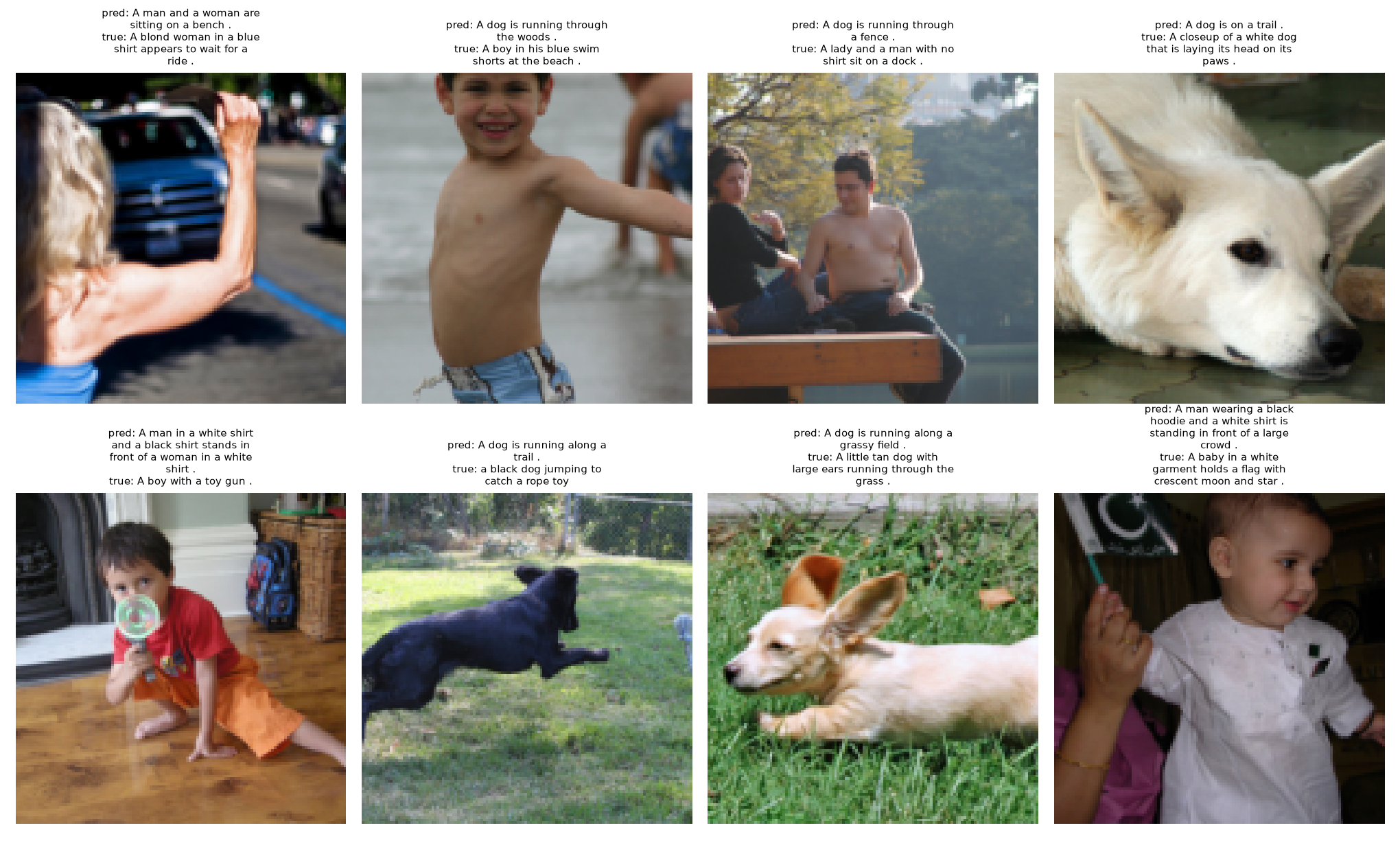
All three actual dog photos in the sample — a close-up white dog, a jumping black Labrador, a
running tan puppy — got correctly dog/running-themed captions
("A dog is running through the woods." / "...along a grassy field." / "...on a trail."),
despite nothing in training ever telling the model “this image contains a dog” directly — that
signal had to travel through CLIP’s frozen features, through a single linear layer, into a frozen
GPT that’s never seen an image, and come out as the right word. The five human/object images got
generically-phrased but broadly on-theme captions (mostly correctly identifying a person, wrong on
specifics) — one real miss, a running boy at the beach, got captioned as a dog, plausibly a motion-
blur/pose confusion inherited from CLIP’s own features rather than something the projection layer
invented on its own. Exactly the shape I’d expect from Stage 1 alone: broad-category grounding
works, fine-grained detail doesn’t, because the language model itself never got a chance to adapt —
the next real lever is upgrading either the frozen CLIP encoder underneath this (still trained on
just 6,000 images, with a fairly small backbone) or unfreezing the GPT for a real Stage 2, not just
running Stage 1 longer.
What I learned
- A doubt worth repeating from the intuition section, because it cost me a wrong first guess: two spaces being aligned for comparison (what CLIP does) is a completely different property from one space being usable as input to some other, unrelated frozen model. CLIP solved the first problem last post; this post’s whole job was the second one.
- “Does the model know a real-world fact” is the wrong test for verifying a from-scratch reimplementation of a pretrained model — it tests a property of the checkpoint’s training data, not of whether your loading code is correct. Numeric parity against the reference implementation (max logit diff, token-for-token generation match) is the actual proof; I nearly mistook a correct implementation for a broken one because of this.
- The
no_grad()scoping mistake is the sharpest new failure mode I’ve hit in this repo so far, specifically because it fails silently — no shape error, no crash, no NaN, just a trainable parameter that never moves while every log line looks completely normal. Worth a real gradient- flow assertion any time a forward pass mixes frozen and trainable submodules, not just a shape check. - A loss plateau with no train/val gap is a different diagnosis than a loss plateau with a growing gap (Phase 1’s ViT, and CLIP’s own run, both showed the latter). No gap plus a plateau means the bottleneck is capacity, not data or regularization — the fix is a bigger/more expressive model somewhere in the chain, not more epochs or more images on the exact same setup.
- Same lesson as the last two posts, in a new form: three correctly-captioned real dog photos told me more about whether this actually works than the 42.6% token-accuracy number did by itself. A metric says how often; a real example says whether the thing that’s supposed to be happening is actually happening.